

European leaders gather in Germany to discuss North Sea clean energy and security. US President Donald Trump’s push to acquire Greenland may take over the agenda.
The region has always feared Russia, but tensions now focus on Trump’s pursuit of Greenland. German Chancellor Friedrich Merz convenes the talks just after Trump dropped his threat to seize the territory by force, according to France 24.
The Greenland Factor: Trump’s “Framework” and NATO Confusion
Trump recently stated that he had reached a “framework” agreement with NATO Secretary General Mark Rutte regarding the territory. This sparked both relief and confusion across Europe as the specific details of this agreement have not been disclosed.
“We will have to pay increased attention to all parts of NATO’s European territory,” Chancellor Merz said Thursday following an extraordinary European Council meeting. “This concerns the North above all.”
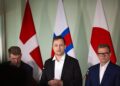
The guest list for Monday’s summit includes Danish Prime Minister Mette Frederiksen, who visited Greenland just days ago, as well as representatives from NATO, the European Commission, and Iceland.
“Given the make-up of the meeting, I am certain that security in the High North will also be of interest to the participants,” said Steffen Meyer, spokesman for Merz.
Hybrid Threats and Maritime Security
The summit aims to expand offshore wind energy, hydrogen, and grid infrastructure across borders. Yet, security concerns dominate. Russia is widely blamed for hybrid attacks in the North and Baltic Seas, such as the suspected sabotage of undersea cables.
Merz emphasized last week that “maritime security” and “shared economic success in the North” would be central topics in Hamburg. His ultimate goal is to transform the North Sea into “the world’s largest reservoir of clean energy,” a move he described as being of “crucial importance for a strong, secure and independent Europe.”
The Energy Gap: Falling Short of 2030 Targets
Despite high ambitions, the energy transition faces big obstacles. The 2023 summit set a goal of 120 GW wind capacity by 2030. Current data shows the region will likely reach only 82 GW by then.
Government sources say fixing industry bottlenecks, parts shortages, and grid issues are key in Hamburg.
Resilience Through Decentralization
Security experts argue that the shift to wind energy is not just a climate necessity but a strategic one. Simon Skillings of think tank E3G noted:
“We’ve learnt a lot over recent years from not just some of the hybrid attacks that have happened on infrastructure, but also looking at the Ukraine-Russia situation. We’ve learnt that dispersed assets are more resilient.”
Skillings added that “A more dispersed infrastructure is more robust… You need basically multiple attacks rather than single attacks to knock out an energy supply.” He concluded, however, that there is still “very little coordination on these issues in the North Sea,” suggesting that building true resilience will require better international cooperation and higher investment.