
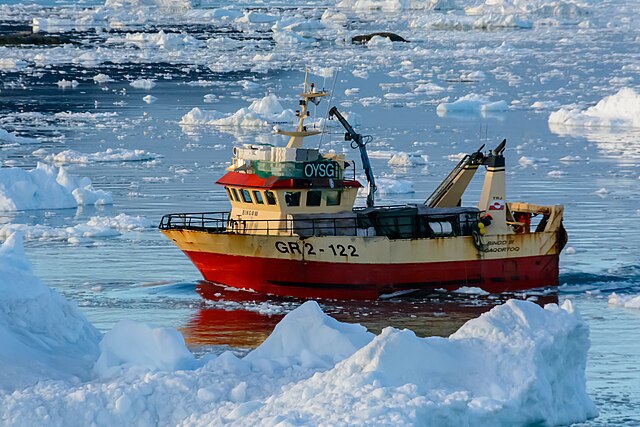
The cold, hard reality facing any U.S., NATO, or European plans for Greenland is the ice, reports ABC News. It chokes harbors, entombs minerals, and freezes shorelines into minefields of white and blue shards that threaten ships year-round.
The only way to navigate these waters is with icebreakers, enormous ships with reinforced hulls and heavy bows designed to crush through frozen seas. However, the United States currently faces a massive strategic deficit.
The Reality of Greenland’s Frozen Coastlines
While the U.S. eyes Greenland’s vast resources, it currently possesses only three icebreakers, only two of which are fully operational. Without specifying a plan, Donald Trump told world leaders at the World Economic Forum in Davos on Wednesday that “to get to this rare earth you got to go through hundreds of feet of ice.”
Yet, there is no meaningful way to do that without specialized vessels. Alberto Rizzi, a fellow at the European Council on Foreign Relations, warns that even if the U.S. moved tomorrow, “they would have a two or three-year gap in which they’re not really able to access the island most of the time.”
“On a map, Greenland looks surrounded by sea, but the reality is that the sea is full of ice,” Rizzi added.
America’s Struggle to Match Russian and Chinese Arctic Fleets
Washington is currently playing catch-up in a new polar arms race. Russia dominates the region with a fleet of roughly 100 vessels, including nuclear-powered giants. Canada is set to double its fleet to 50, and China, with five ships already, is rapidly expanding its ambitions.
“China is now in a position to develop indigenous icebreakers, and so the U.S. feels it must do the same,” says Marc Lanteigne, a professor at the University of Tromsø.
Sophie Arts, a fellow at the German Marshall Fund, notes that the current U.S. fleet is “basically past its life cycle already.” She emphasizes that Washington cannot solve this alone: “Cooperation is what makes this possible … the U.S. doesn’t really have a pathway to do this on its own at this time.”
Finland’s Geopolitical Leverage: The Expertise Washington Needs
If the U.S. wants more icebreakers, it must rely on its allies, specifically Finland. The Nordic nation has built about 60% of the world’s icebreaker fleet.
“It’s very niche capabilities that they developed as a necessity first, and then they have been able to turn it into geoeconomic leverage,” Rizzi explained.
This expertise is now a critical diplomatic tool. Both Canada and Finland have recently faced criticism and tariff threats from the Trump administration regarding Greenland, yet they hold the keys to the Arctic. “Both Canada and Finland are really, really vital to this,” Arts said.
The Ice PACT: A Strategic Necessity for the U.S.
To address the shortage, the U.S. signed the “Ice PACT” with Helsinki and Ottawa. This agreement aims to deliver 11 new icebreakers. Under the deal, four will be built in Finland, while seven will be constructed in U.S. shipyards using Finnish designs and Canadian-U.S. joint ownership.
However, the costs are staggering. Beyond the ships themselves, the price of building defensive facilities, such as the proposed $175 billion Golden Dome missile defense network, would be enormous.
Arctic Security and the European Bargaining Chip
This technical dependency gives Europe significant leverage in its relations with the U.S. While Finland is unlikely to scrap the deal, the EU could use its expertise as a bargaining chip against unilateral U.S. actions.
Rizzi suggests a potential hardline stance: “If Europe wants to exercise significant leverage over the USA, they could say ‘We’re not going to give you any icebreakers and good luck reaching the Arctic, or projecting power there, with those two old ships that you have.’”
In Davos, European Commission President Ursula von der Leyen pointedly reminded the world of this European advantage. “Finland — one of the newest NATO members — is selling its first icebreakers to the U.S.,” she said. “This shows that we have the capability right here… and above all, that Arctic security can only be achieved together.”